
When looking for a small online tool, we often want to solve a specific problem quickly. With AppErgo, I try to keep that idea in mind: the tool should be useful without turning a simple action into a complicated process.
The problem with small tools that make things complicated
Sometimes, all we need is a tool for a very simple action: counting characters, changing text case, generating a password, picking a random number, or starting a timer.
In these situations, every obstacle quickly becomes annoying. A window blocking the screen, a mandatory sign-up, an overloaded page, or a button that is difficult to find can be enough to make people lose patience.
This is often the moment when we close the tab and look for a more direct website.
Not asking for more than necessary

Not all services have the same needs. For some websites, a user account is essential: it can save data, keep a history, manage preferences, or synchronise a personal space.
But many small tools do not need that. A timer does not need to know who I am. A text counter does not need my email address. A random number generator does not need to recognise me from one visit to the next.
We already all have many accounts here and there: on online shops, forums, social networks, and other online services. I do not want to add another mandatory layer for tools that simply do not need one.
This does not mean that AppErgo will never have a section with user accounts. Such a section could make sense one day, but it would not be intended for visitors who simply want to come to the site, use a tool, and leave.
It would rather be for people who want to go further. For example, if AppErgo one day offered a more ambitious Windows application, a space reserved for a few beta testers could be useful to track bugs, centralise feedback, and gradually improve the software.
On AppErgo, I therefore try to not ask for more than necessary. For small everyday web tools, the tool should answer the intended need without imposing sign-up or collecting personal information that does not help it work.
Free access as a starting point
Small online tools are the kind of resources we often use occasionally, sometimes without even thinking about it. They help with a small task, save time, and then we move on.
I have long benefited from this type of free tool on the web. It therefore feels natural to offer AppErgo’s tools in the same spirit.
Free access does not mean that everything is perfect or final. AppErgo is still an evolving project. But it at least keeps the entry point simple: visitors arrive, try the tool, and immediately see whether it suits their needs.
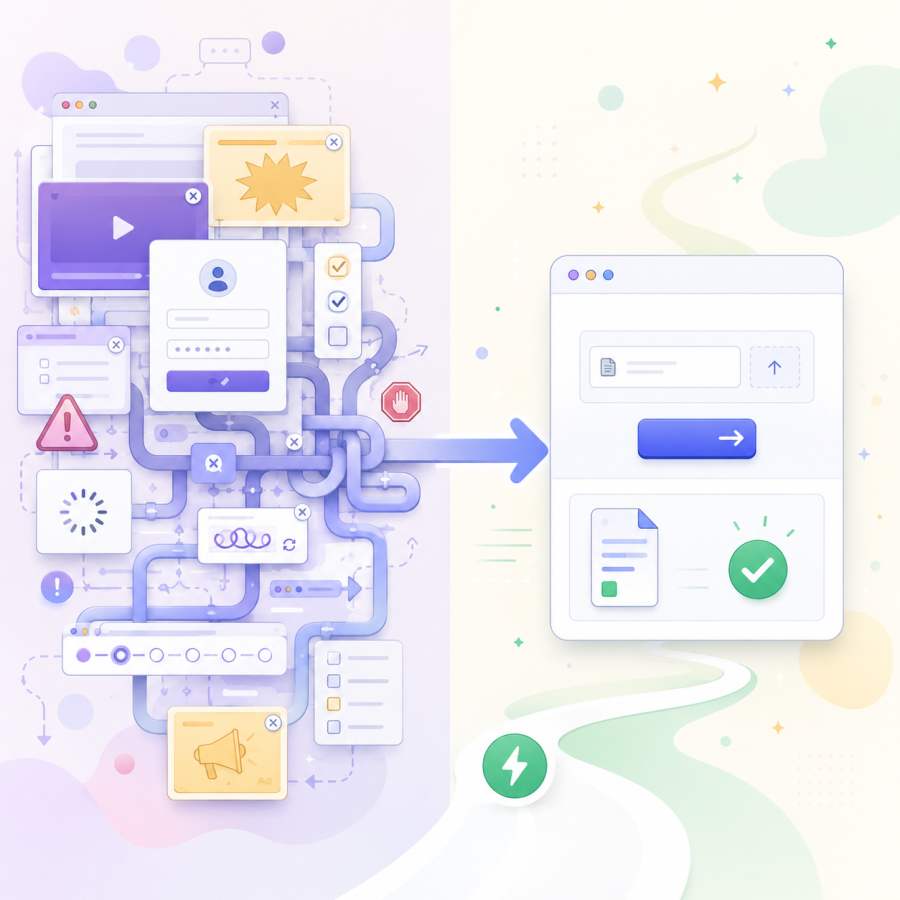
An interface that gives users room to breathe
Advertising is not the only problem. What is especially frustrating are the elements that take control of the page: pop-ups, mandatory surveys, messages that hide the content, or repeated requests to disable an ad blocker.
These mechanisms sometimes give the impression that users first have to fight with the page before they can access what they came for.
I do not want to build AppErgo in that spirit. A web tool should remain readable, clear, and pleasant to use. If advertising appears one day, it will have to stay in a corner of the page: visible, but discreet, non-aggressive, and never placed in a way that blocks access to the tool or interferes with its use.
Ergonomic and respectful tools
A web tool should not merely work. It should also be simple enough not to require unnecessary effort.
This is where ergonomics matters. An ergonomic tool does not try to impress users with an accumulation of options. It helps them quickly understand what to do, where to act, and how to get the expected result.
This approach also concerns privacy and personal data. A small tool should not ask for personal information when it is not needed. It should not create unnecessary doubt about what is being sent, stored, or analysed.
A link with AppErgo’s other commitments

Free access, the absence of mandatory accounts, and the refusal of intrusive advertising are only part of the approach. They belong to a broader vision for AppErgo’s web tools, alongside other important points such as lightweight pages, speed, ease of use, security, and privacy.
These principles are presented in more detail in the article about AppErgo’s six commitments for its web tools.
A simple rule: respect the user
In the end, the idea is quite simple: a small tool should respect the person using it.
That means respecting their time, of course, but also their attention, comfort of use, privacy, and personal data. A tool should be quickly available, easy to understand without unnecessary effort, and should not add constraints that have nothing to do with the initial need.
AppErgo is not perfect yet, and many things will continue to evolve. But this rule will remain important: to provide tools that are genuinely useful, without forcing users to fight against an interface, endure interruptions, or provide unnecessary personal information.