
AppErgo is moving to version 0.9. This version marks an important step in the evolution of the website: after several months spent on the general structure and on the development of the web tool catalogue, the objective is now clear: finalise this catalogue in preparation for the future v1.
From v0.8 to v0.9: a long construction phase
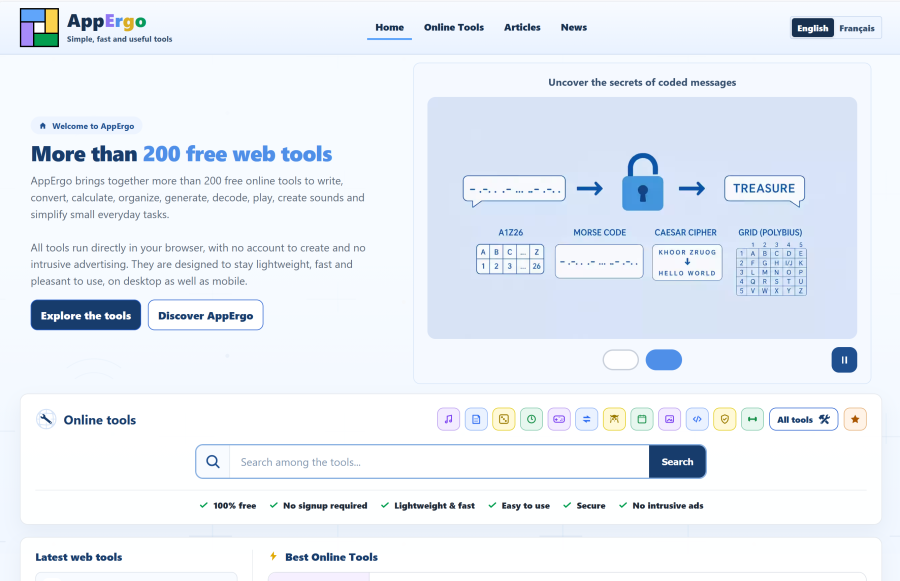
Version 0.8 has had a special place in AppErgo’s history. It lasted longer than some previous versions because it supported a major evolution of the website. With v0.8, AppErgo went from around ten web tools to more than 150, which deeply changed the scale of the project.
The following versions, from v0.8.1 to v0.8.9, then made it possible to stabilise many tools, add new ones, revise some interfaces, and gradually improve the organisation of the website. Today, AppErgo has 232 web tools. Around 180 of them are already usable in good conditions, although one final light correction pass will still be carried out. The remaining tools, around fifty of them, still need to be corrected, finalised, simplified, or sometimes rewritten.
Finalising the web tool catalogue
Version 0.9 therefore opens a new work phase, with one priority objective: finalising the web tool catalogue. For the future v1, the goal is not simply to display a large number of tools. The real objective is for the catalogue to be genuinely presentable to the public, with tools that are stable, understandable, useful, and pleasant to use.
Some tools will probably be removed if they are not relevant enough or no longer fit the direction of the site. Others may be added if their usefulness is clear. But one thing is certain: by version 1.0, AppErgo will offer around 200 stable, fully usable web tools. This milestone is important, because a large catalogue only has value if it remains coherent, reliable, and polished enough to make people want to explore it.
A much more complete homepage
Version 0.9 also brings a real focus on the homepage. It is becoming clearer, livelier, and more useful. Its role is no longer only to present AppErgo quickly, but also to guide visitors towards the web tools, articles, news, and important content on the website.
The design has been improved, the structure has been strengthened, and several blocks now make it easier to highlight what matters. The homepage should quickly give visitors a good idea of what AppErgo is, what they can do there, and what is changing on the website. This work also concerns the mobile experience, with clearer navigation, more comfortable blocks, and more direct access to essential content on smartphones.
v0.9.1 and the carousel: the finishing touch for the homepage
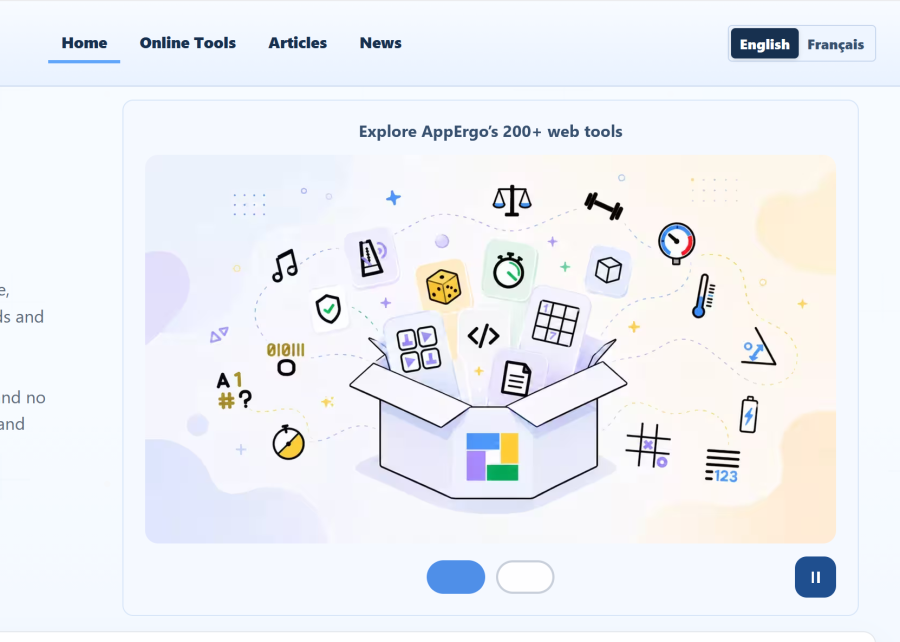
Version 0.9.1 arrived shortly after v0.9, with the addition of a carousel in the main homepage block. This carousel is, in a way, the finishing touch for the new homepage. It can display up to five blocks combining an image, a link, and a short text. Visitors can choose which block to display, pause the animation, and then continue browsing simply.
It is not just a decorative element. The carousel makes the homepage feel livelier while remaining consistent with the new design. It also makes it possible to highlight several important pieces of content without overloading the first visible area of the page.
The carousel works with CSS only. This avoids adding JavaScript for this feature and helps preserve the lightweight nature of the homepage. Since it depends on several images, I will also make sure to use light files, especially SVG or AVIF where possible. The homepage will therefore no longer have exactly the same weight as before: instead of being around 45 KB, it should rather sit somewhere between 50 and 100 KB depending on the images displayed. That remains extremely light for a modern website, especially for a richer, livelier, and more pleasant homepage.
This is a good example of what I want to do with AppErgo: add useful features without turning a simple page into a heavy or confusing interface. The website’s performance has been preserved as much as possible.
Performance remains central to the project
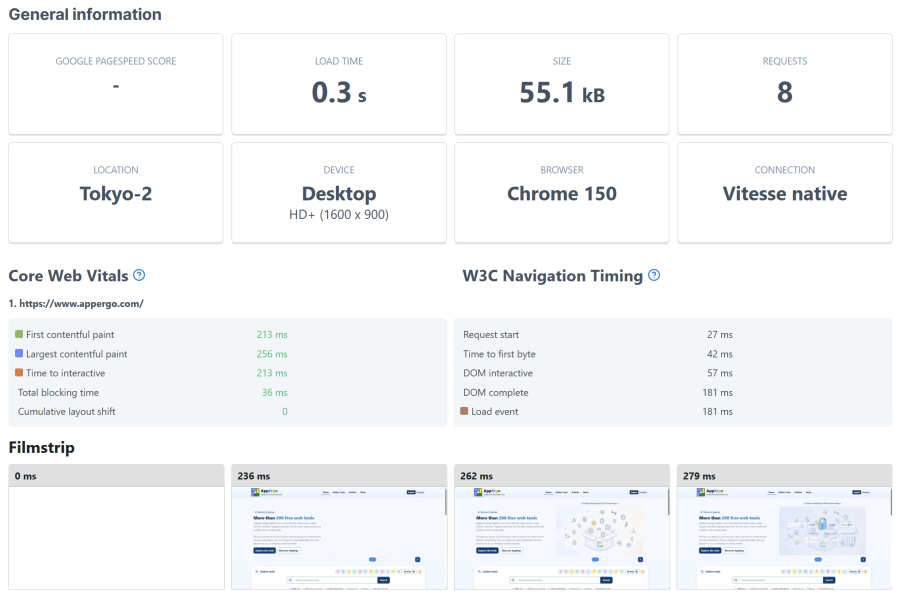
AppErgo’s lightweight approach remains important, even as the website gains more content and features. During the v0.8 cycle, I also integrated Cloudflare to make the website more accessible internationally. Since AppErgo’s server is located in France, loading times could be longer from distant countries such as Brazil, Japan, or Australia.
Even with very lightweight pages and a low number of requests, these delays could sometimes reach 2.5 to 3 seconds, or even a little more depending on conditions. With Cloudflare, international performance has improved significantly. Loading times generally fall below 2 seconds. When the cache starts being used, they tend to move closer to 1 or 1.5 seconds. And when the cache is fully warm, the results can become impressive, with loading times around 0.2 to 0.5 seconds.
This work confirms an important idea for AppErgo: a website can evolve, offer more content, and become better structured while remaining fast, lightweight, and pleasant to use.
A better organised website
With v0.9, the visible structure of the website has also been refocused. The main menu has been simplified. Sections related to future Windows software, such as projects, forge, or utilities, have been removed from the main menu and placed in the footer. The downloads section has even been made temporarily less visible.
This choice is deliberate. For now, the active heart of AppErgo remains the website and its web tools. It therefore makes more sense for the main menu to highlight the truly active parts: the homepage, online tools, articles, and news. AppErgo is not abandoning its future Windows applications, but as long as they are not yet at the centre of the public website experience, it is more coherent not to give them too much space in the main navigation.
Articles and news are better integrated
The Articles section is also taking on a more important role. Articles help explain the project, document its evolution, present the choices made, and give visitors more context. They are not just there to fill the website: they help tell the story of AppErgo’s gradual construction.
But this section will not be limited to project news. I would also like to share technical information there, especially around web development, the design of online tools, ergonomics, and the choices made throughout the development of the website. Articles may also cover subjects I enjoy, such as treasure hunts, puzzles, codes, and simple encryption methods: Caesar, ROT13, Atbash, Morse, A1Z26, and other systems often used in games, challenges, or clue-based searches.
This editorial opening fits AppErgo well: the website already offers practical tools, but it can also become a place to explain, experiment, and share content related to tools, uses, and the subjects that inspire them. Article management has also been improved. Pages can now be generated automatically, such as indexes or category pages, which makes content organisation easier on the administration side.
A News page also brings together the website’s updates. It makes it possible to follow tool additions, updates, fixes, version changes, and successive improvements. It also shows that AppErgo is a living website that evolves regularly.
Better management on the administration side
Version 0.9 does not only improve what visitors see. It also improves how the website can be managed. The homepage can now highlight certain pieces of content more easily. It is possible to select the tools displayed, better organise articles, manage news, and adapt visible content more precisely according to needs.
This work on the administration side is less visible, but it matters a lot. AppErgo already contains many pages, many tools, and two language versions. To keep evolving cleanly, its management also needs to remain clear and manageable.
French and English versions will live in parallel
AppErgo was designed from the start as a bilingual website, in French and English. Until now, the two versions tended to work like mirrors: an article in French had to have its English version, a news item in English had to have its French version, and so on. With v0.9, this logic becomes more flexible. The French and English versions can now live in parallel, without being required to be identical.
This independence can already be seen on the homepage. The two versions share the same foundation, but they can have a slightly different atmosphere. The English version, more international, uses a very clean presentation, with a very light blue header and background, making it more sober and professional. The French version uses a dark blue header and a warm white background, slightly yellow, giving it a warmer and more personal feeling.
This flexibility also applies to highlighted content. Some articles or news items may exist in one language before the other, or may not be published in both languages if there is no particular reason to do so. Similarly, the French homepage may highlight one selection of tools while the English homepage highlights another. This will make it possible to better adapt AppErgo to its visitors, without artificially forcing both versions of the website to remain perfectly synchronised.
Delaying Windows applications again, but for good reasons
I am therefore delaying C++ development and the future Windows applications once again. This is not an abandonment. It is more a matter of priority. Before building higher, what is already in place needs to be properly finished.
Stabilising the website, finalising the web tools, clarifying the structure, improving the homepage, better organising articles, and making the catalogue genuinely presentable: all of this remains a priority before moving on to the next stage. Once this phase is complete, AppErgo will be able to live more calmly. The website will of course continue to evolve, with new articles, occasional tool improvements, fixes, or the addition of new utilities. But it will no longer require the same foundation work.
That is when I will be able to focus more on Windows applications.
From foundations to construction
Looking back, AppErgo’s evolution can be understood in several major stages. From v0.1 to v0.6, the foundations of the website were laid: general structure, first pages, visual identity, first sections, and project organisation. From v0.7 to v1, these foundations will have been strengthened. The structure and design will have progressed, but above all, the web tools will have become a major addition. They will have transformed AppErgo into a genuinely useful website, not just a project showcase.
From v1 onwards, the goal will no longer be to strengthen the foundations in the same way. It will be more about building on top of them. The future parts related to Windows software, such as the forge, utilities, downloads, or bug reporting, will not arrive as a random extra layer. They will rely on what has already been put in place.
An important transition
Version 0.9 is therefore a transition version, but an important one. It does not mark the end of the work on AppErgo. Instead, it prepares the last major stage before v1: finalising the web tool catalogue and making the website solid, clear, and presentable enough to move more calmly towards what comes next.
AppErgo has not yet reached its first major stable public version, but it is getting closer. Version 0.9, quickly completed by v0.9.1 and its carousel, marks precisely this moment: the point where the foundations are advanced enough to prepare the next stage more seriously.