
Creating a password, calculating the hash of a text or checking an older checksum are three operations often grouped under the term “security”, but they address very different needs. AppErgo’s Security category currently brings together three tools: a password generator, a SHA-256/SHA-384/SHA-512 generator and a tool dedicated to MD5, SHA-1 and CRC32. They all work directly in the browser, but the values they produce should not be used in the same way.
Password Generator: create a truly random secret
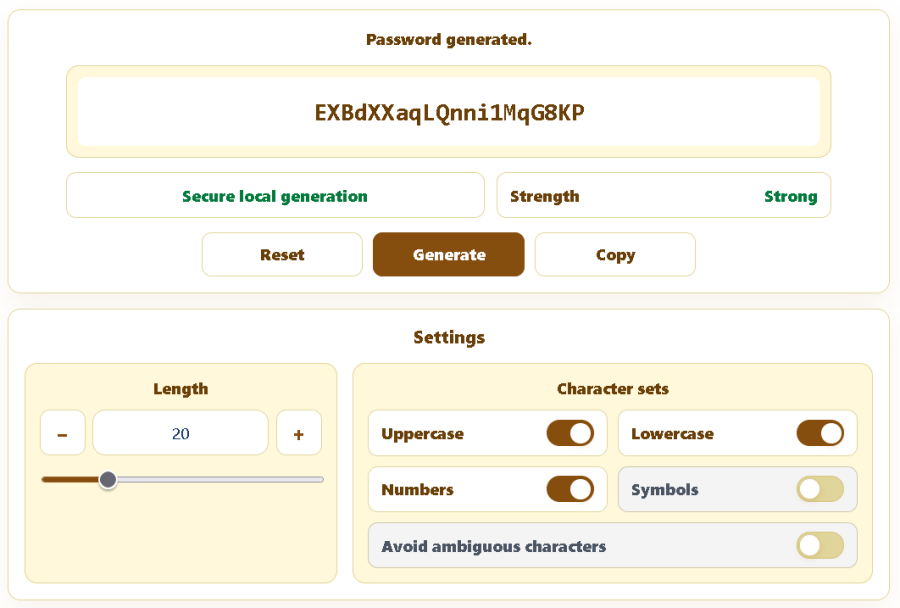
The Password Generator creates random combinations from 8 to 64 characters using lowercase letters, uppercase letters, numbers and symbols as needed. Each selected character group is represented in the result, and an option can exclude easily confused characters such as 0 and O or 1 and l when the password needs to be copied manually or dictated.
The main benefit is avoiding predictable human habits: common words, dates, names, keyboard patterns or constructions such as Password123!. Length and genuine randomness matter more than artificial complexity applied to a very short string. For important accounts, using a different password for each service is also essential; a password manager can store long, unique combinations without requiring you to memorize them all. When available, two-factor authentication adds another layer of protection independent of the password itself.
Generation is performed locally and, when available, uses the browser’s cryptographic API. The generated password therefore does not need to be sent to or stored on the AppErgo server.
SHA Generator: calculate a modern cryptographic hash
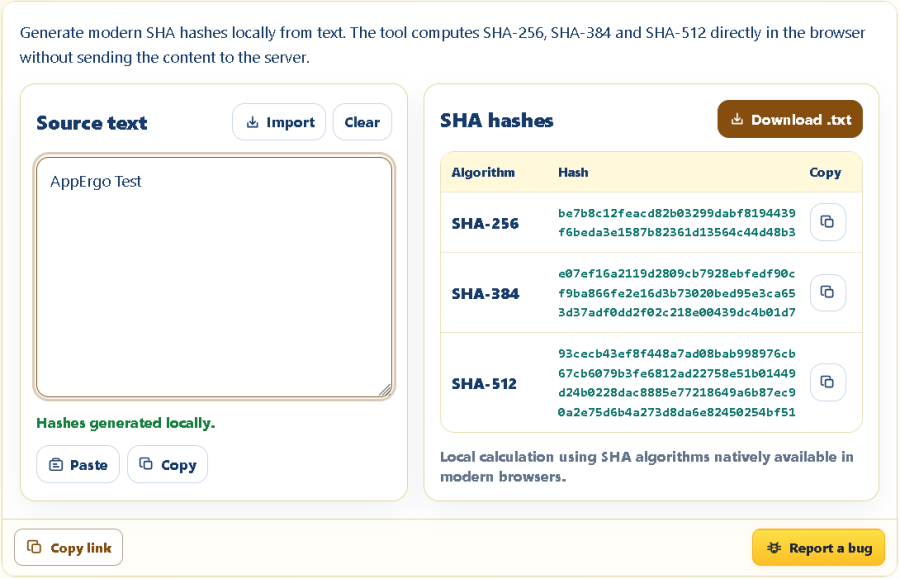
The SHA Generator calculates SHA-256, SHA-384 and SHA-512 hashes from text using the browser’s Web Crypto API. A hash function transforms data into a fixed-length fingerprint: SHA-256, for example, produces a 256-bit value generally represented by 64 hexadecimal characters. Changing even a single character in the input normally produces a very different hash.
Hashing should not be confused with encryption. Encrypted content is intended to be decrypted with the appropriate key; a SHA hash is not designed to allow the original text to be recovered directly. It can instead be used to compare two pieces of data or verify that content exactly matches the data that produced a known hash.
SHA-256 and SHA-512 are modern cryptographic hash functions, but that does not mean hashing a password once is enough to build a secure authentication system. Password storage uses specialized mechanisms, including unique salts and deliberately expensive functions designed to slow down large-scale guessing attempts. The AppErgo generator is therefore a hash calculation tool, not a complete password-management system.
MD5, SHA-1 and CRC32: compatibility, legacy systems and error checking
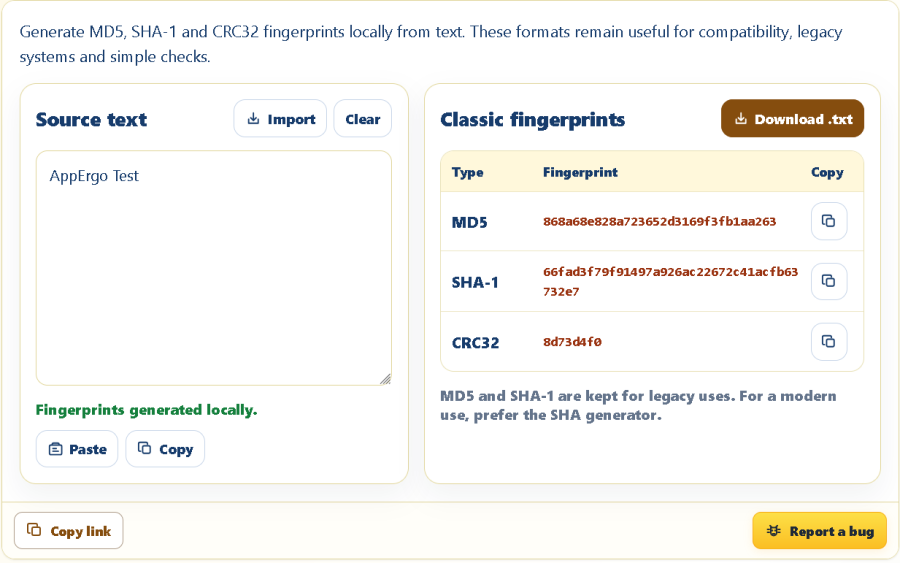
The MD5, SHA-1 and CRC32 Generator is mainly intended for compatibility needs. MD5 and SHA-1 are still found in older software, archives, documentation and databases, but weaknesses in their collision resistance make them unsuitable for new applications requiring modern cryptographic security. Their presence in the tool is therefore intended to reproduce or verify existing values, not to recommend these algorithms for new systems.
CRC32 belongs to a different category altogether. It is a checksum mainly designed to detect accidental errors in data, such as corruption during storage or transfer. It is fast and very useful for this purpose, but it was not designed to resist an attacker deliberately modifying data while attempting to produce a misleading value. CRC32 should therefore not be treated as cryptographic protection.
The length of a result can sometimes help identify its likely format: CRC32 generally produces 8 hexadecimal characters, MD5 32, SHA-1 40, SHA-256 64, SHA-384 96 and SHA-512 128. This remains only a clue, since the length of a string alone cannot prove which algorithm produced it. The input must also match exactly: an extra space, capital letter or line break is enough to change the hash.
Three security tools for three different uses
The Password Generator creates a new secret, the SHA Generator calculates a modern cryptographic hash, while the MD5, SHA-1 and CRC32 tool is mainly intended for legacy formats and checksums. All three perform their calculations directly in the browser without sending passwords or entered text to the AppErgo server. They are available in the Security category.