
A workout can rely on very different reference points. In running, pace is often expressed in minutes per kilometer. Interval training is instead structured around alternating work and recovery periods. Tabata follows an even more specific format: 20 seconds of work followed by 10 seconds of rest. AppErgo’s Fitness category currently brings together three tools for these different uses: calculating a running pace, freely organizing intervals or quickly starting a Tabata session. They provide useful measurements and timing without trying to define a training program for the user.
Pace Calculator: connect distance, time and running pace
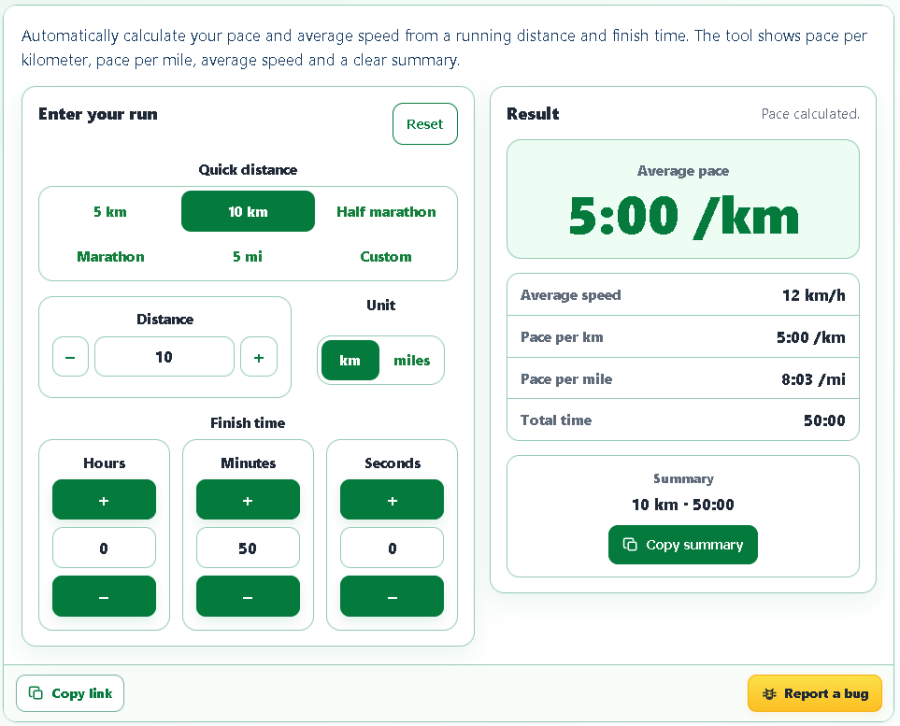
The Pace Calculator uses a distance and a time to automatically calculate the average pace in minutes per kilometer and per mile, as well as the corresponding average speed. It can be used after a run to compare performances, but also before a race to turn a target finishing time into an average pace. For example, completing 10 km in 50 minutes corresponds to an average pace of 5:00 min/km, or 12 km/h.
Pace works in the opposite direction to speed: the fewer minutes required to cover one kilometer, the faster the pace. The tool also avoids small mistakes with decimal minutes: 5.5 minutes means 5 min 30 s, not 5 min 50 s. Several common distances are available directly, including 5 km, 10 km, half marathon, marathon and 5 miles, along with a custom distance option.
The result remains an average. A pace of 5:00 min/km over 10 km does not mean that every kilometer was completed in exactly five minutes. Terrain, elevation, wind, stops and the accuracy of the measured distance can all affect individual splits and should be considered when comparing different runs.
Interval Timer: freely structure an interval workout
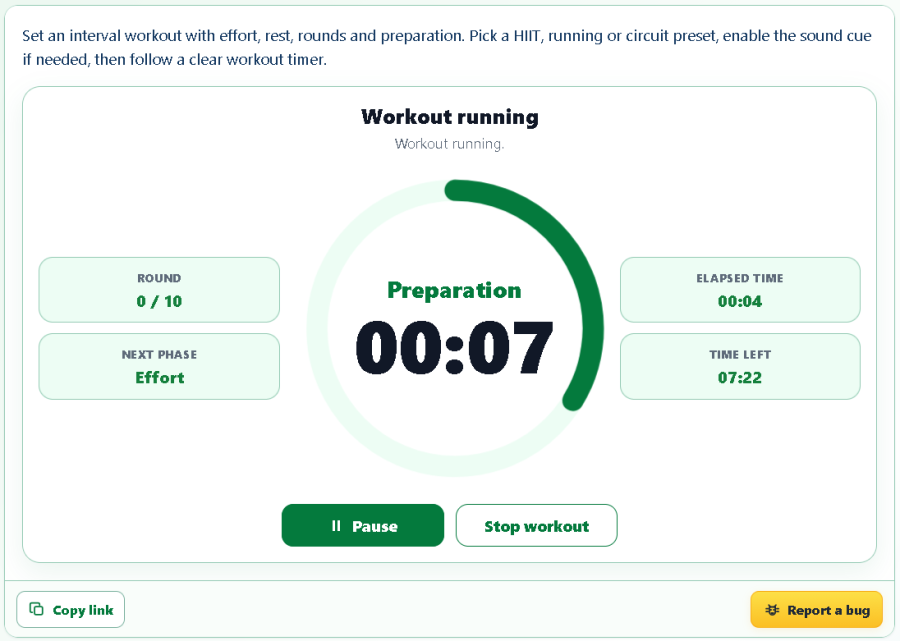
The Interval Timer automatically alternates between work and recovery phases. You can set a preparation time, work duration, rest duration and number of rounds, then let the timer handle the sequence. It can be used for running intervals, HIIT, circuits, strength exercises, jump rope or any other activity organized around timed intervals.
Presets make it quicker to start with some common formats, while all settings remain adjustable. During the session, the screen shows the current phase, remaining time, current round and next phase. An optional sound signal can also indicate transitions without requiring you to keep watching the screen. The timer finishes at the end of the final work interval and does not add an unnecessary recovery period after the last round.
The tool only organizes time. A session using 45 seconds of work and 30 seconds of rest can represent very different levels of effort depending on the exercise, intensity and individual. The timer therefore provides a timing structure, not a training prescription.
Tabata Timer: start a 20/10 format immediately
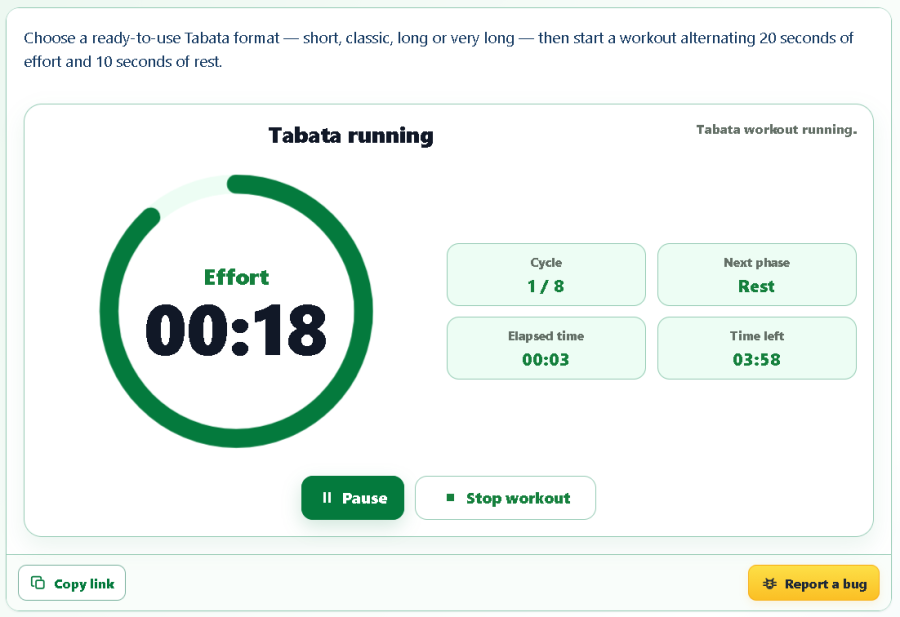
The Tabata Timer follows the same interval principle but with a deliberately simpler approach: 20 seconds of work followed by 10 seconds of rest. There is no need to configure each interval before starting.
Four formats are available: 2, 4, 6 or 8 minutes. A classic 4-minute Tabata therefore consists of 8 cycles of 30 seconds. During the session, the interface shows the current phase, cycle, next phase, remaining time and overall progress, with an optional sound signal.
The Tabata Timer does not replace the Interval Timer: it is specifically designed for workouts following the 20/10 format. For a different structure, such as 30/30, 45/15 or two minutes of work followed by one minute of recovery, the customizable interval timer is more appropriate.
Three tools to measure and structure a workout
The Pace Calculator helps understand running pace, the Interval Timer freely organizes work and recovery phases, while the Tabata Timer focuses on immediate use with its 20/10 format. All three tools work directly in the browser and are available in AppErgo’s Fitness category, with no installation or account required.