
A message made up of numbers, dots and dashes, or unusual groups of letters is not necessarily “encrypted” in the cryptographic sense. It may use a classic cipher, a transmission code, a correspondence between letters and numbers, or simply a computer representation of text. A sequence such as 19 5 3 18 5 20, a message like ... --- ..., and a string such as 01000001 can all hide text, but they do not rely on the same principle. This first part dedicated to AppErgo’s Codes tools focuses on these direct transformations of characters and their representations.
Before decoding: cipher, code or representation?
A cipher transforms a message according to a rule and, in some cases, a key. With Caesar, every letter is shifted by the same number of positions. Vigenère instead uses several shifts determined by a keyword. Atbash replaces each letter with the one located at the opposite end of the alphabet.
Other systems rely more on a correspondence. With A1Z26, A becomes 1, B becomes 2, and so on. The Polybius square represents a letter using the coordinates of its cell. In Morse code, a character becomes a sequence of short and long signals. The goal is not necessarily to hide the information, but to represent it according to a different convention.
ASCII, binary and hexadecimal are something else again. They represent characters or data in numerical forms. A puzzle can take advantage of their technical appearance to make a message less immediately readable, but that does not make them ciphers.
Transforming the alphabet: Caesar, ROT, Atbash and variable shifts
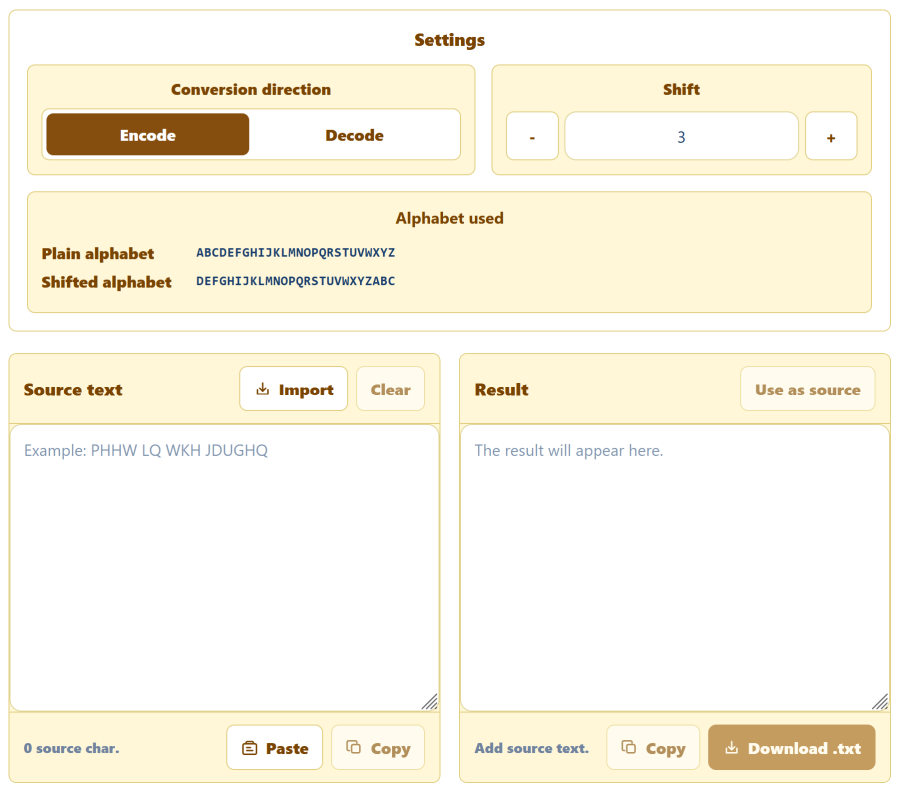
The Caesar Cipher is one of the simplest examples. Each letter is shifted by the same number of positions in the alphabet. With a shift of 3, A becomes D, B becomes E, and Z wraps around to become C. When the shift is unknown, the Automatic Caesar Decoder lets you compare all 25 non-trivial possibilities directly.
The ROT family follows the same basic idea with predefined transformations. ROT13 shifts letters by 13 positions and reverses itself when applied a second time. ROT5 works with digits, ROT18 can combine letters and numbers, while ROT47 extends the principle to a large part of the printable ASCII character set. The ROT Tool makes it possible to compare several variants in the same interface.
Atbash follows another very simple rule: the alphabet is completely reversed. A becomes Z, B becomes Y, C becomes X, and so on. The transformation is symmetrical, meaning that applying the same operation again restores the original text.
The Vigenère Cipher introduces variable shifts. A keyword determines a sequence of different displacements, so the same letter in the original text may produce different characters depending on its position. In a puzzle, recognizing Vigenère may therefore be only the first step: you still need to discover the key, which may be suggested by a title, an illustration or another clue.
The Keyword Shift tool explores a related idea with greater flexibility. A word can be converted into successive values used as shifts, including the A = 0 and A = 1 conventions. A numerical sequence such as 3 1 4 1 5 can also be used directly. This can be an interesting approach when a puzzle explicitly provides a word or several numbers that appear intended to shift the letters.
Turning letters into numbers, coordinates or signals
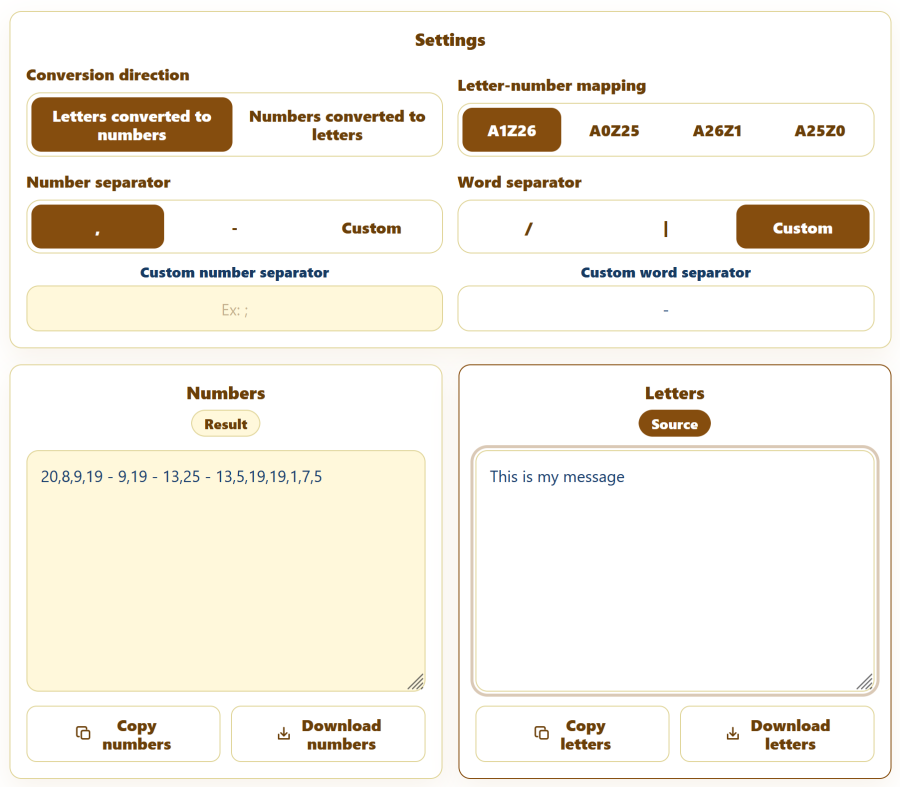
A1Z26 is based on an immediate correspondence: A = 1, B = 2, up to Z = 26. The word SECRET therefore becomes 19 5 3 18 5 20. AppErgo also lets you test variants starting at 0 or using the alphabet in reverse order, which can be useful when the creator of a puzzle has chosen a different convention.
The Polybius Square places letters in a 5 × 5 grid and represents them using pairs of coordinates. A sequence such as 11 43 25 may therefore point toward this family of systems. Depending on the convention used, the coordinates may be read row-column or column-row.
Tap Code uses a closely related principle, but transmits those coordinates as groups of taps. A cell at position 4,3 can, for example, be represented by four signals followed by three. These signals can take the form of sounds, flashes, dots or almost any repeated elements that can be counted.
The Bacon Cipher is based on groups of five elements with only two possible states, traditionally A and B. Those two states can, however, be represented in many different ways: uppercase and lowercase letters, two colors, two fonts, two shapes or two orientations. A hidden message can therefore be embedded in the appearance of a text that remains perfectly readable on its own.
Morse Code associates each character with a combination of short and long signals. Dots and dashes are simply a convenient written representation: the same principle works with sounds, flashes or two different symbols. The AppErgo tool also lets you use custom characters when decoding.
Other systems can appear in puzzles without having been designed to hide anything. The NATO Phonetic Alphabet, for example, turns CODE into Charlie Oscar Delta Echo to make spoken communication less ambiguous. The Braille Translator works with an actual writing system, while the Roman Numerals Converter helps interpret the symbols I, V, X, L, C, D and M. Their presence can provide a clue without any true cipher being involved.
ASCII, binary and hexadecimal: different views of the same information
ASCII Code, Binary Code and Hexadecimal Code are closely related. They can represent exactly the same information in different forms.
| Representation | Value for A |
|---|---|
| Character | A |
| ASCII decimal | 65 |
| Hexadecimal | 41 |
| Binary | 01000001 |
Binary uses only 0 and 1. Hexadecimal uses sixteen values, from 0 to 9 and then A to F, allowing one byte to be represented with only two characters, from 00 to FF. A hexadecimal string is therefore much more compact than its binary equivalent.
For modern characters outside the historical ASCII table, the binary and hexadecimal tools work with UTF-8. An accented character may therefore require several bytes, which explains why the number of resulting groups does not always match the number of visible characters.
These representations can also form only the first layer of a puzzle. A hexadecimal conversion may, for example, produce FRPERG. The result still looks strange, but ROT13 then gives SECRET. Obtaining unreadable text after a first conversion does not necessarily mean that the initial approach was wrong.
How can you quickly recognize the right approach?
The shape of a message can often eliminate many possibilities before you even start decoding:
- Ordinary letters but unreadable text: Caesar, ROT, Atbash, Vigenère or another substitution.
- Numbers mainly between 1 and 26: A1Z26 or a variant.
- Pairs of numbers between 11 and 55: Polybius square or another grid-based system.
- Groups of five elements using only two values: Bacon cipher.
- Dots, dashes or two types of signals: Morse code is one possible starting point.
- Groups of eight 0s and 1s: binary representation of bytes.
- Pairs mainly using 0-9 and A-F: hexadecimal.
- Values such as 65, 66, 67 or 97: decimal ASCII.
- Alfa, Bravo, Charlie, Delta…: NATO phonetic alphabet.
- I, V, X, L, C, D and M: Roman numerals.
- Cells such as ⠉⠕⠙⠑: Braille.
These clues are not proof. A sequence of 0s and 1s may be binary, but it could also be a mask used to select certain positions. Numbers between 1 and 26 may represent letters, but they could just as easily indicate positions in a text or grid.
The most useful skill is often recognizing the structure of a system rather than its exact appearance. Morse can use two geometric shapes instead of dots and dashes, Bacon can use two colors instead of A and B, and Tap Code can use flashes rather than taps. A puzzle can preserve the underlying mechanism while completely changing the way it is presented.
A first family among AppErgo’s Codes tools
The systems presented here are particularly well suited to learning, experimentation, escape games, treasure hunts, and creating or solving puzzles. They should not, however, be confused with modern cryptographic mechanisms designed to genuinely protect sensitive information. Caesar has very few possible keys, ROT13 and Atbash use virtually none, and Vigenère has long been obsolete for real security purposes. Morse, Braille, ASCII, binary, hexadecimal and the NATO phonetic alphabet are not protection mechanisms at all.
This first family in AppErgo’s Codes category mainly relies on directly transforming characters or the way they are represented. But a message can also preserve exactly the same letters and become unreadable simply because they are no longer being read in the correct order.
The second article in this series will focus on those transpositions, grids, diagonals, spirals and extraction methods. The third will then address the most difficult situation: analyzing a message when you do not yet know which system was used.