A secret message does not necessarily need to replace A with D, a letter with a number, or a character with Morse code. It can preserve exactly the same letters as the original text and become unreadable simply because they are no longer in the correct order. This is the principle behind transposition ciphers, but also many puzzles based on grids, diagonals, spirals, acrostics or regular extraction patterns. With this type of problem, the question is no longer simply “what does this character mean?”, but rather “in what order, or at which positions, should I read the characters that are already in front of me?”. This second part dedicated to AppErgo’s Codes tools explores precisely this other way of hiding a message.
Transposing text without changing its letters
In a substitution cipher such as Caesar, characters are replaced while their general order remains unchanged. A transposition does the opposite: the original letters are preserved but rearranged. A transposed text therefore still contains exactly the same characters in the same quantities, even when all recognizable words have disappeared.
Rail Fence illustrates this principle well. The message is written in a zigzag across several rows, called rails, and those rows are then read one after another. The number of rails completely changes the result and therefore becomes an essential parameter when trying to recover the original text.
The Scytale also relies on the arrangement of characters. Historically associated with a message written on a strip wrapped around a cylinder, it can be represented digitally as a grid whose width determines how the letters are arranged and then read. Choosing the wrong width does not change a single letter, but it is enough to make the result unreadable.
With Column Transposition, the grid becomes explicit. Text can be arranged vertically and then read horizontally, using different dimensions and several possible starting corners. Two grids containing exactly the same number of cells can therefore produce very different results depending on their width, height or orientation.
Mirror Reading handles a simpler form of rearrangement. “Read backwards” can mean reversing the characters in each word, reversing the order of the words, reversing the characters on each line, or even reversing the order of the lines themselves. These operations are elementary, but different enough to make a deliberately vague clue surprisingly effective.
A grid multiplies the possible reading orders
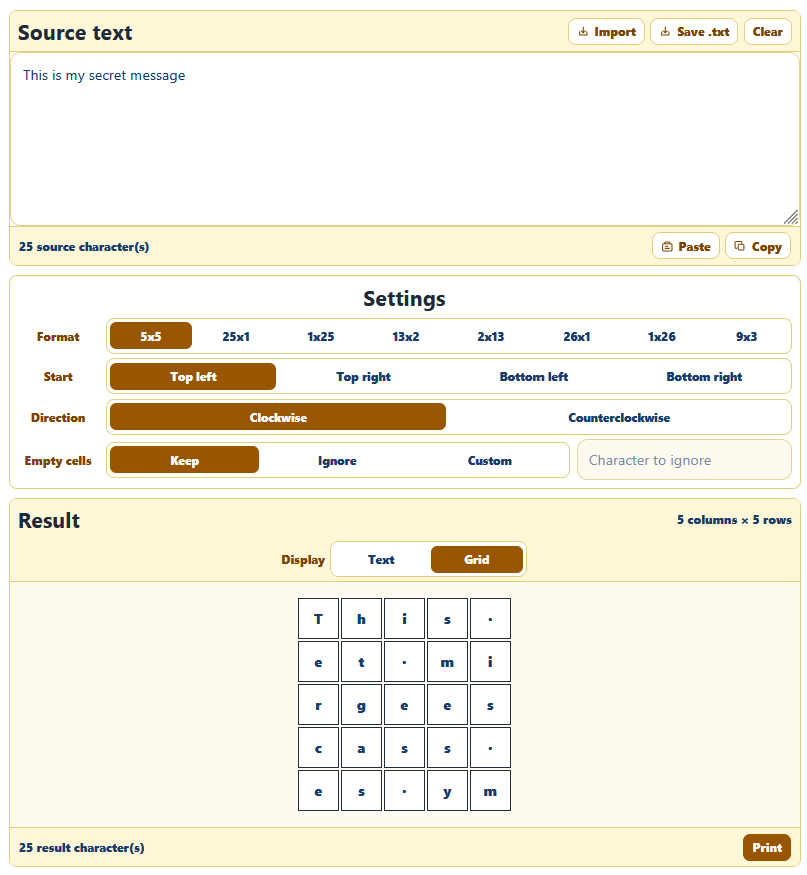
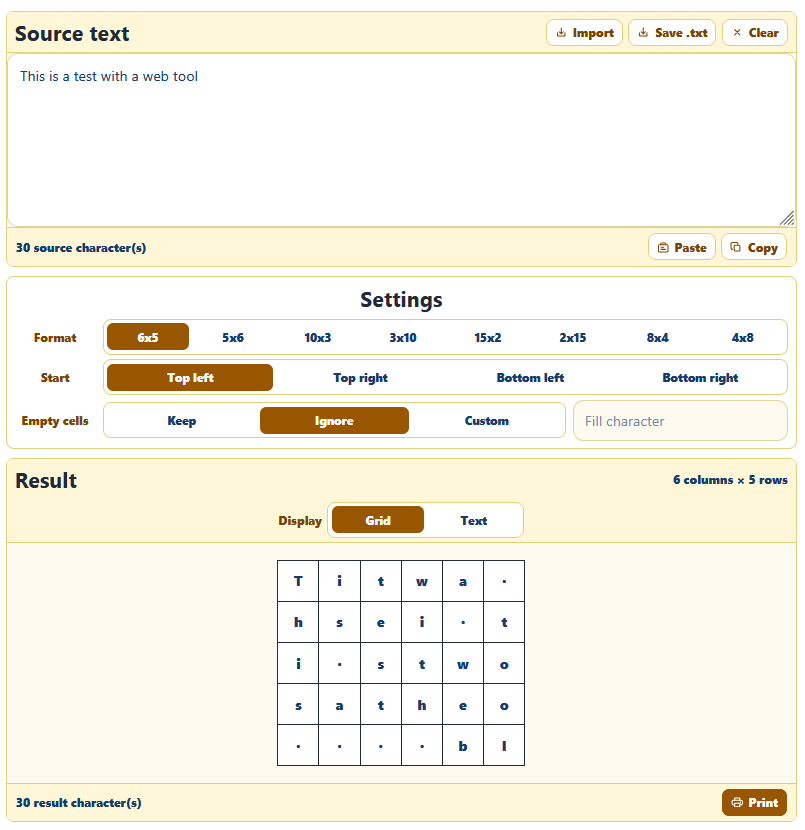
Turning a sequence of characters into a grid immediately adds a second dimension. The same content can now be read horizontally, vertically, right to left, bottom to top, in a snake pattern, diagonally, in a spiral or according to a list of coordinates.
The Grid Code tool lets you experiment with several of these arrangements. A text that looks completely meaningless when read line by line may become readable simply by alternating the direction of each row or changing the starting point.
Grid Coordinates follow another approach: you no longer need to read every cell. A sequence such as B2 D4 A1 C3 can specify exactly which positions should be extracted. As with other coordinate systems, however, it is important to determine whether the letter represents a column or a row and to take any labels provided by the puzzle into account.
Spiral Reading turns the grid into a path that gradually winds toward its center. The starting corner and clockwise or counterclockwise direction completely change the route. A shell, whirlpool, snail or even a simple clue such as “turn” may be enough to suggest the method without revealing the solution directly.
Diagonal Reading instead explores oblique directions. Once again, the grid dimensions matter: the same text arranged across five columns or six columns will not produce the same diagonals.
When there is no obvious reading direction, the Grid Reader can compare several common paths using the same layout, while the Grid Tester becomes useful when even the dimensions are unknown.
The length of the text can then provide a first clue. A string of 64 characters naturally fits an 8 × 8 grid, 100 characters a 10 × 10 grid, and 144 characters a 12 × 12 grid. This is obviously not proof, but dimensions that fill a grid exactly are often good first candidates to test.
The message can also be hidden inside perfectly readable text
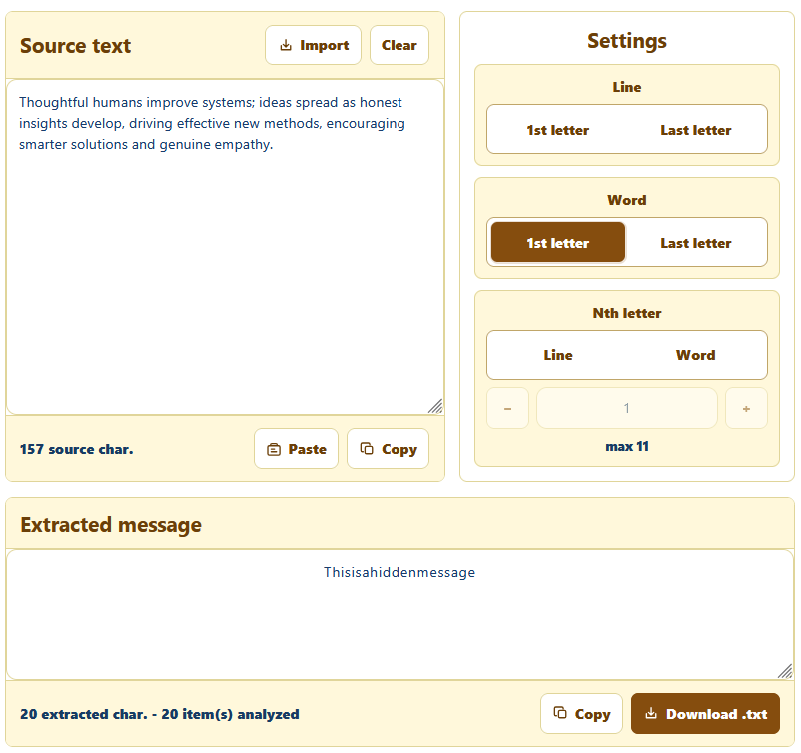
A puzzle does not need to present an unreadable cryptogram. A second message can be hidden inside a paragraph, poem or series of sentences that already have a perfectly normal meaning of their own.
The Acrostic Extractor can retrieve the first or last letters of lines or words, as well as a fixed position. A text whose line openings seem unusually deliberate may therefore contain a completely independent message.
The Nth Letter Word Extractor takes this idea further. A rule may ask for the second letter of every word, the first letter of the first word followed by the second of the next, or a sequence of positions determined by a clue. With a few words, counting remains easy; across several paragraphs, a tool quickly prevents mistakes.
The Text Mask works directly with positions in a string. Keeping every second character, every third character or a custom list of positions may be enough to reveal a second reading. A pattern such as 10110 can also be repeated across the text, keeping positions corresponding to 1 and ignoring those corresponding to 0.
The Letter Extractor combines several of these approaches and can work on the entire text, line by line or word by word. It also lets you choose what actually counts toward the positions: letters only, letters and digits, or the raw text including spaces and punctuation. This difference is far from trivial, since keeping a single space shifts every position that follows.
Finally, Sequence Extraction applies numerical sequences to character positions: prime numbers, the Fibonacci sequence, perfect squares, multiples or a custom list. When a puzzle contains a mathematical clue, the sequence itself may therefore determine which letters should be kept.
Creating, printing and manipulating a grid
Grids are not useful only for decoding. They can also be used to create a puzzle or to experiment physically with different hypotheses.
The Simple Word Search Grid places a list of words into a grid and fills the remaining cells with random letters. Allowed directions can be limited to rows and columns for a simpler puzzle, or expanded to diagonals and reversed words to increase the difficulty.
The Printable Text Grid places a message into regular cells and prepares it for printing. Several placement modes can be used, including rows, columns, snake patterns and spirals.
The Printable Blank Grid provides the same kind of support without imposing any content. For some geometric puzzles, paper remains particularly practical: you can rotate the grid, draw a path, use tracing paper, cut out a mask or circle selected cells without altering the original text.
How do you choose a reading method?
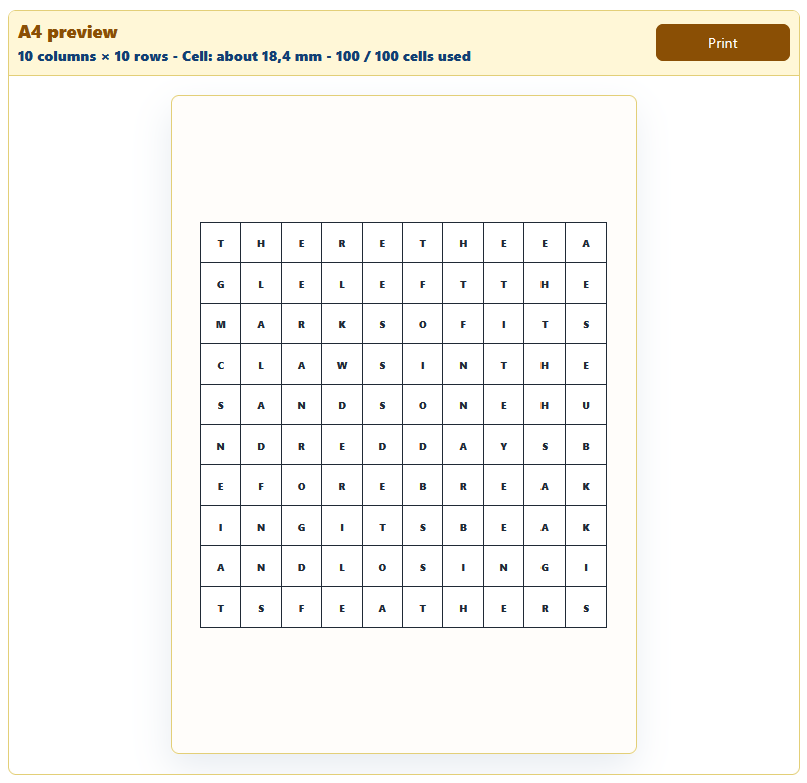
When faced with a grid or a text that seems to contain a hidden message, it is usually more efficient to start with the simplest rules before multiplying transformations:
- The letters look plausible but no words appear: consider a transposition such as Rail Fence, scytale or columns.
- The text already forms a table: try rows, columns, reversed directions and snake patterns before more complex paths.
- An image suggests rotation: test spiral reading with different starting corners.
- A grid contains many apparently useless letters: look for diagonals, coordinates or selected cells rather than trying to use everything.
- A paragraph seems artificially constructed: inspect initials, final letters or the same position within each word.
- A clue provides a series of numbers: consider using those values as positions or as an extraction rule.
- Prime numbers, Fibonacci or squares are mentioned: test sequence extraction.
The layout itself is often part of the puzzle. A poem naturally invites examination of its lines, a grid suggests spatial reading, coordinates probably point to particular cells, and a succession of equal-length lines may hide a grid without drawing one explicitly.
It is also important not to assume that every character must be used. Some letters may simply serve as filler, just as a paragraph may have been written mainly to place selected characters in the correct positions.
Read differently before looking for another alphabet
A transposition has one particularly useful property: it preserves the characters of the original text. If a French or English message has simply been rearranged, it still contains exactly the same number of each letter. The words disappear, but the overall distribution of characters has not been replaced as it would be with a substitution.
This can provide a useful clue, although several methods can also be combined. A text may first be encrypted with Caesar and then placed in a spiral grid. Reading the grid correctly will not immediately produce plain language: it will simply recover the Caesar text, which must then be decoded in turn. Likewise, an acrostic may reveal an A1Z26 sequence, coordinates may provide a keyword, and a diagonal may produce an instruction intended for another text.
This second family in AppErgo’s Codes category is therefore less concerned with what a character means than with where it is located and the order in which it should be read.
One situation remains even more difficult: receiving a message without knowing whether it uses a substitution, a transposition, a numerical code, a grid, or even a perfectly ordinary-looking text containing a hidden clue. The third article in this series will focus precisely on that analysis stage: observing an unknown message, identifying its properties and choosing the first approaches worth testing.