
Receiving a coded message is relatively straightforward when you already know the method: if you know it uses Caesar, Morse or A1Z26, you simply apply the corresponding rule. The real difficulty begins when you have absolutely no idea what you are looking at. A sequence of numbers may represent letters, coordinates, ASCII values or positions. A text containing only letters may use Caesar, Atbash, Vigenère, a substitution, a transposition, or no cipher at all. In a treasure hunt, escape room or puzzle, the first step is therefore not necessarily to decode anything. It is mainly about observing the message, identifying its structure and gradually reducing the number of plausible hypotheses. This third and final part dedicated to AppErgo’s Codes tools focuses precisely on that analysis stage.
Observe the message before transforming it
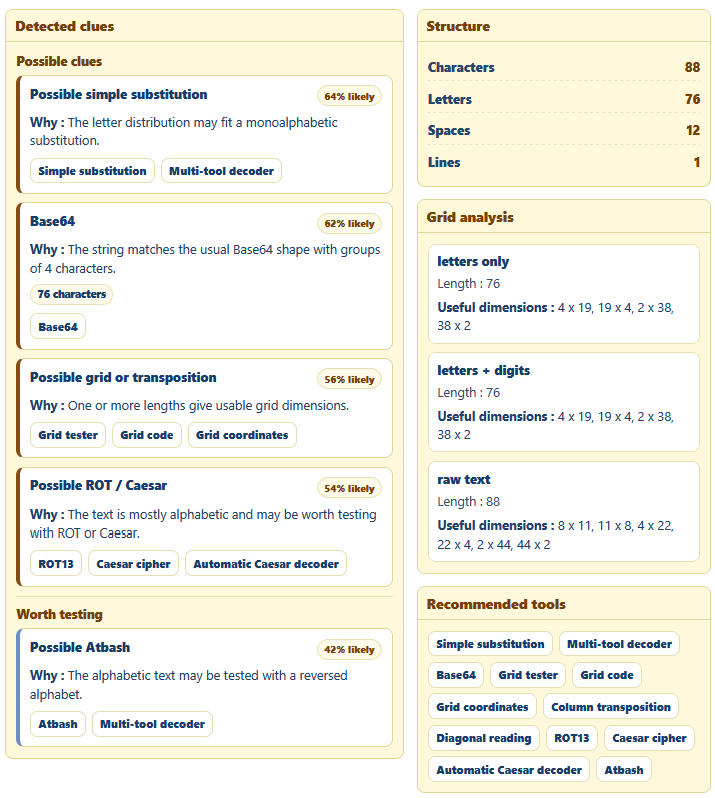
When a text looks coded, it can be tempting to immediately remove spaces, punctuation or unusual characters. It is usually better to begin by keeping an exact copy of the original message. An extra space, an isolated capital letter, a different accent or even an invisible character may be part of the puzzle.
The Code Detector is designed for this initial exploration. It examines the visible structure of the message, the types of characters used, numbers, separators, regular groups and even dimensions that may be compatible with a grid. It can then suggest possibilities such as Morse, binary, ASCII, A1Z26, Caesar, substitution or a grid.
A suggestion is not a certain identification, however. A string of 0s and 1s naturally suggests binary, but it could also be a mask. Numbers between 1 and 26 may represent letters, but they may just as easily be positions. The detector is therefore mainly intended to answer a more useful question: which hypotheses are actually worth testing?
The Character Types tool can then distinguish and, when useful, extract letters, digits, spaces, punctuation and other symbols. In an apparently ordinary paragraph, isolating a few numbers or unusual capital letters may reveal information that was easy to overlook.
Once these checks have been made, the Puzzle Text Cleaner can create a copy adapted to the analysis: normalize case, remove accents, delete spaces or punctuation, keep only letters, or regroup characters. The important point is to clean the text according to the hypothesis being tested without destroying the original.
Frequencies, repetitions and positions: what letters can reveal
When a message mainly contains letters, their distribution can provide useful clues. The Letter Frequency tool counts occurrences from A to Z and calculates their proportions in the text. In a simple substitution, the frequencies found in the original language are transferred to different letters but remain broadly present. A particularly common character may therefore be a candidate for E in English, although this is never proof on its own.
Statistics become much more useful when the message is long enough. With only three or four characters, almost no reliable conclusion can be drawn. Across several paragraphs, however, recurring letters, repeated words, double letters and repeated patterns become easier to identify. Frequency analysis should therefore be combined with the structure of the message rather than treated as an automatic decoding rule.
The Letter Duplicates tool quickly highlights characters that appear repeatedly, only once or not at all. Repetition is particularly useful with monoalphabetic substitution: if the same encrypted character occurs twice in succession, the two corresponding characters in the plain text must also be identical.
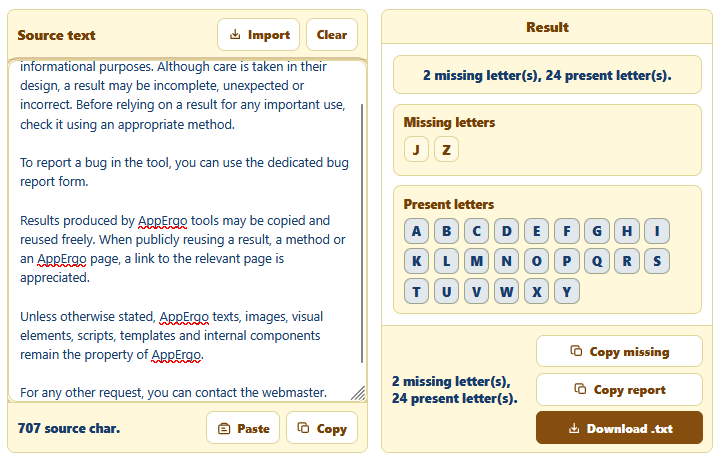
Missing Letters can also provide a clue. A text deliberately written without a particular letter is a lipogram, while a sentence or text using every letter of the alphabet is a pangram. In a puzzle, a surprisingly systematic absence may therefore be intentional.
Finally, Letter Positions focuses not only on how often a character appears but on exactly where it occurs. This becomes useful when a clue asks you to select specific characters or when you want to verify a regular pattern. Depending on the context, you may also need to count every character, letters only, or start numbering at 0 rather than 1.
Test the least expensive hypotheses first
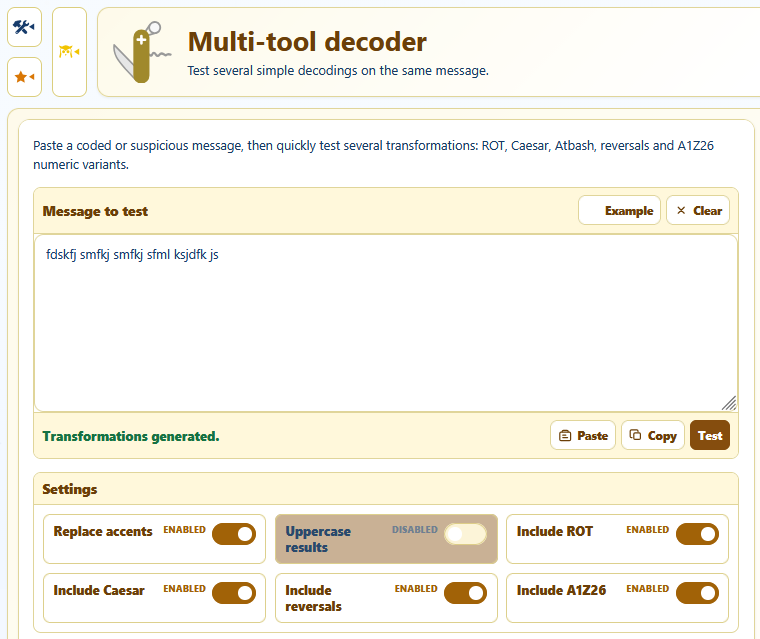
Before spending an hour reconstructing a substitution, it is generally worth checking the simplest transformations first. The Multi-Tool Decoder applies several common methods to the same message so their results can be compared quickly. Caesar, ROT13, Atbash and mirror reading are simple enough to test and eliminate almost immediately.
When Caesar seems plausible, the Automatic Caesar Decoder can directly test all 25 non-trivial shifts. If none of the results resembles coherent text, the classic Caesar hypothesis quickly becomes much less likely.
If spaces are preserved, several words repeat and identical letter patterns appear in different places, a simple substitution becomes more plausible. The Simple Substitution tool lets you build a correspondence table progressively instead of trying to guess all 26 letters at once.
The Frequency Decoder combines this approach with the statistics of the text. It provides a table in which different correspondences can be tested progressively while immediately showing their effect on the whole message. Frequencies provide candidates, but the resulting words, repetitions and structures determine whether a hypothesis really holds up.
The Random Alphabet tool can be used to create or reconstruct a complete substitution alphabet, while the Alphabet Checker verifies that a supposed key contains each of the 26 letters exactly once. If one letter appears twice, another must necessarily be missing, which is enough to make the substitution alphabet invalid.
Numbers and differences can form a second message
Some clues are less directly related to letters. The Number Extractor, for example, can isolate every numerical value found inside a paragraph. The resulting sequence can then be tested as A1Z26, positions, dates, grid dimensions or other parameters.
The GPS Coordinates Extractor searches more specifically for pairs that are compatible with geographical coordinates. Two numbers falling within the valid latitude and longitude ranges are obviously not proof by themselves, but the idea becomes far more convincing when the puzzle refers to a map, a location, north or some form of geographical movement.
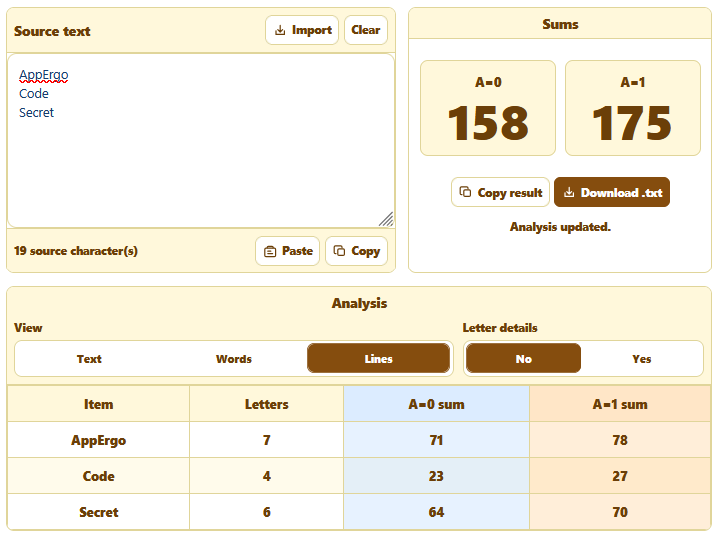
Letter Sums can turn a word into a numerical value using conventions such as A = 0 or A = 1. The result cannot be used to reconstruct the original word automatically because several strings may produce the same sum, but it can help compare keywords or connect a word with a number found elsewhere.
Letter Distance instead examines successive movements through the alphabet. A sequence such as A D G J immediately reveals regular shifts of +3 even though the letters themselves form no word. Such a sequence may represent a pattern or provide a key for another stage of the puzzle.
Two almost identical versions of a text also deserve close attention. The Text Comparator can identify precisely which characters were added, removed or changed, while Difference Message goes further by treating those differences themselves as possible information. Changes in case, accents or punctuation may form a hidden message of their own.
A simple method for analyzing an unknown message
There is no universal procedure, but a logical progression avoids a great deal of unnecessary trial and error:
- Keep the original message before making any changes.
- Observe its form: letters, numbers, symbols, separators, groups, spaces and repetitions.
- Test the obvious possibilities with the Code Detector and simple transformations.
- Create a cleaned copy only once you know which elements can safely be removed.
- Study frequencies and patterns if the text resembles a substitution.
- Examine numbers and differences separately when they appear to carry information of their own.
- Return to transpositions and grids if the letters look natural but no substitution produces a convincing result.
This final step connects this third article directly with the previous one. If the letter frequencies resemble those of a natural language but the characters appear simply to be in the wrong order, the Grid Tester can provide a useful bridge toward Rail Fence, scytale, column transposition, diagonals or spirals.
It is also important to remain cautious about false positives. If you test enough grid sizes, shifts, masks and extraction rules, you will almost always produce a few letters that vaguely resemble a word. A convincing solution should ideally be suggested by the structure of the message or by a clue, use a simple and reproducible rule, and explain a substantial part of the message without requiring numerous exceptions.
Solving a puzzle is mainly about reducing the possibilities
When faced with an unknown message, trying every available method is usually not the best strategy. The number of combinations quickly becomes enormous once ciphers, keys, grid dimensions, orientations, extraction methods and numerical conventions start being combined.
Solving the puzzle relies more on a succession of small observations: which characters are being used? Do the spaces look natural? Are the groups a regular size? Are some letters unusually frequent? Do two words share the same pattern? Does the length suggest a grid? Do the numbers look more like positions or coordinates?
A good decoding tool therefore does not replace reasoning. Its main purpose is to perform tedious operations quickly: counting several hundred letters, testing every Caesar shift, comparing two paragraphs character by character or gradually rebuilding a substitution table.
The three main families in AppErgo’s Codes category therefore complement one another naturally. The first article focused on codes, ciphers and representations that directly transform characters. The second covered transpositions, grids and extraction methods, where the challenge is to recover the correct reading order. This final part applies when you do not yet know which of those approaches to use: observe the message, measure its properties and progressively test the most credible hypotheses.