
Converting kilometers to miles, degrees Celsius to Fahrenheit or kilograms to pounds is straightforward. Other conversions require more attention: area, energy, flow rates, digital storage, fuel consumption and scientific units do not always follow the same rules. AppErgo’s Conversion category brings together 33 tools covering everything from everyday measurements to units used in mechanics, electricity, computing, photometry and fluid mechanics. The Unit Converter covers the most common needs, while specialized tools provide more units for each field.
Common conversions
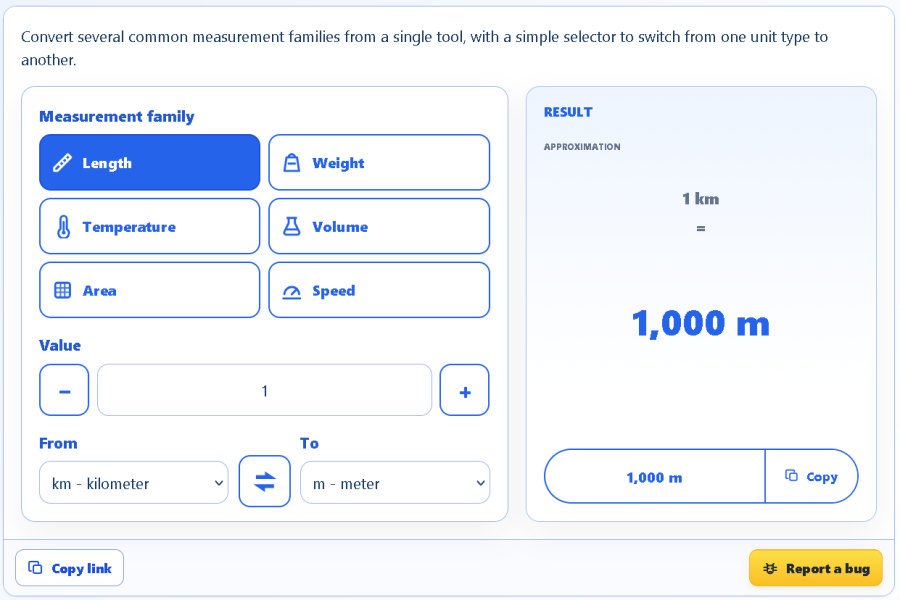
The length, weight and mass, volume, area, temperature and speed converters make it easy to switch between metric, imperial and other commonly used units.
AppErgo also provides a Historical Length Converter for feet, toises, perches, leagues, cubits and other measurements found in historical documents. Since some of these varied depending on the period or region, custom reference values can also be added.
Energy, mechanics and fluids
More technical needs are covered by converters for energy, power, specific heat capacity, acceleration and frequency.
Mechanics has dedicated tools for force, torque and pressure. For fluids, there are converters for volumetric flow rate, mass flow rate, density, dynamic viscosity, kinematic viscosity and surface tension.
These tools remain separate because similar-looking units do not necessarily describe the same quantity. Converting a flow rate from liters per hour to kilograms per hour, for example, requires knowing the density of the fluid.
Electricity, light and digital data
For electricity, AppErgo provides converters for electric charge, electrical units, electric field and magnetic field.
The digital tools convert storage units and data transfer rates. They distinguish, for example, between GB and GiB as well as bits and bytes, helping avoid the common confusion between Mbit/s and MB/s.
Two converters deal with light: illuminance, commonly expressed in lux, and luminance, often expressed in cd/m² or nits.
A few conversions with their own rules
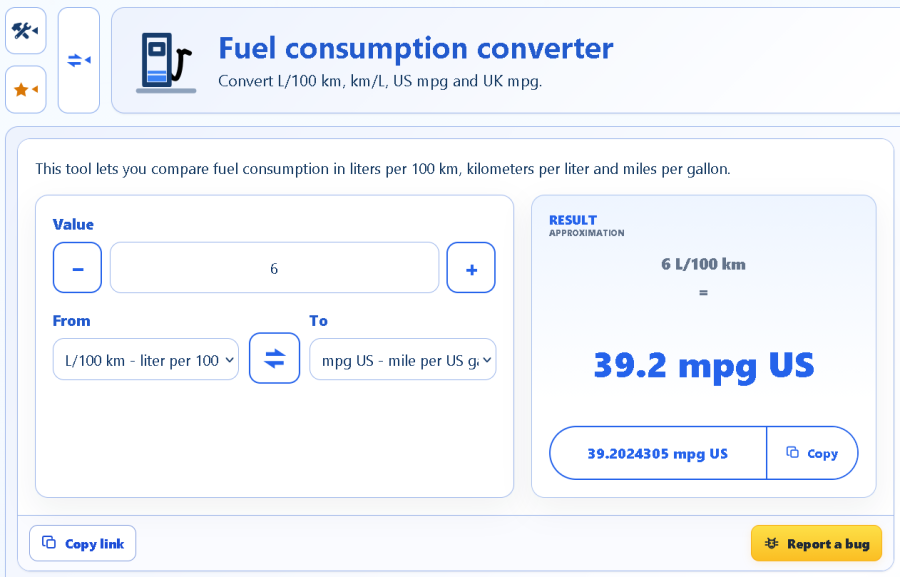
The Fuel Consumption Converter switches between L/100 km, km/L and mpg, with separate US and imperial gallons. Its logic is unusual because L/100 km decreases as efficiency improves, while km/L and mpg increase.
Angles can be converted between degrees, radians, gradians, turns, arcminutes and arcseconds. A separate Solid Angle Converter handles units used for three-dimensional angles, particularly in astronomy, optics and photometry.
Choose the right quantity before the unit
Most conversion mistakes come less from the calculation itself than from confusing two different quantities. kW cannot be converted to kWh without a duration, volumetric flow cannot become mass flow without density, and a battery capacity in mAh is not enough to determine its energy without knowing the voltage.
All 33 converters are available in AppErgo’s Conversion category. Calculations are performed directly in the browser, with no account, installation or need to send the entered values to the server.